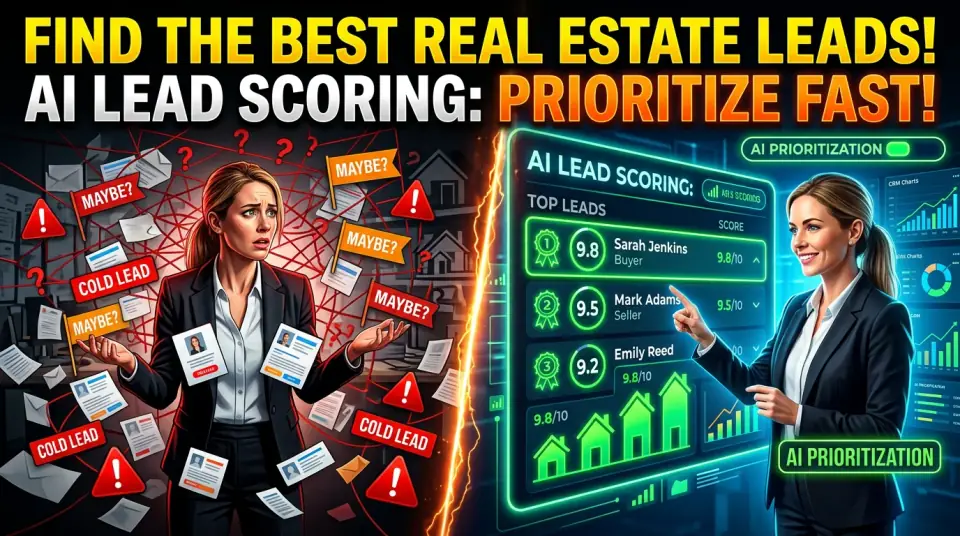
AI lead scoring is becoming one of the most practical uses of artificial intelligence in real estate because it solves a daily problem agents actually feel: too many names in the CRM, not enough clarity about who deserves a call right now.
Most agents do not have a lead shortage in the abstract. They have a prioritization problem. One portal lead wants to see a condo this weekend. One home valuation lead is quietly comparing agents. One old buyer from three years ago just opened five market update emails. Another contact clicked once because they were curious and then disappeared.
Manual follow-up treats those people too similarly. AI lead scoring gives each contact a score based on behavior, source, timing, fit, and engagement so agents can work the hottest opportunities first.
That matters because real estate lead generation has gotten more expensive and noisier. NAR’s 2025 REALTOR Technology Survey found that social media, CRM systems, and MLS tools remain among the top lead-generating technologies for agents, while 66% of REALTORS say they adopt technology to save time. Lead scoring sits directly in that gap: it helps agents save time without abandoning personal follow-up.
What AI lead scoring means in real estate
AI lead scoring is the process of ranking real estate leads by their likelihood to become a real conversation, appointment, listing, buyer consultation, or closing. A basic CRM might score a lead because they opened an email. A stronger AI lead scoring system looks at patterns across many signals.
Those signals can include search activity, property views, saved homes, repeat website visits, home valuation requests, email clicks, text replies, call outcomes, neighborhood interest, price range, timeframe, source quality, CRM history, and whether the lead’s behavior is accelerating.
The point is not to let software decide who matters. The point is to help agents see intent faster.
A buyer who views one listing at 11 p.m. might be casual. A buyer who returns the next morning, saves three homes in the same school district, opens a mortgage email, and asks about showings deserves a different level of urgency. A seller who requests a home valuation, revisits the valuation page twice, clicks a pricing guide, and opens a recent market update should not sit behind 40 cold Facebook form fills.
Want a Lead System That Shows You Who to Call First?
We help agents build real estate lead generation systems with scoring, routing, follow-up, and conversion tracking built in.
Why lead scoring is suddenly more important
The old online lead playbook was simple: buy leads, call everyone, hope the math works. That approach breaks when lead volume rises, response expectations shrink, and agents are already stretched thin.
MarketingSherpa has long reported that organizations using lead scoring see a major lift in lead generation ROI compared with teams that do not score leads. Real estate is not a traditional B2B funnel, but the principle translates cleanly. Agents do not need every lead to be perfect. They need a better way to decide which lead gets speed-to-lead attention, which lead gets nurture, and which lead should stop eating the day.
The timing also lines up with how agents are already using technology. NAR reports that CRM is one of the top lead-generating technologies for REALTORS, and 59% say they use some emerging technology while still learning. In other words, many agents already have the container for scoring leads. They just have not turned the data into a daily operating system.
AI makes scoring more useful because it can notice combinations humans miss. A single email open is weak. A pattern of emails, listing views, seller content clicks, SMS replies, and return visits is different. AI lead scoring can connect those dots across the buyer and seller journey.
The best signals to include in a real estate lead score
A useful real estate lead score should combine intent, fit, engagement, and timing. If the score is based on only one category, it will create false positives.
Intent signals show that someone is moving beyond casual research. These include home valuation requests, showing requests, saved searches, repeated visits to the same property, mortgage calculator activity, pricing guide downloads, open house registrations, and replies to your emails or texts.
Fit signals show whether the lead is aligned with your business. A luxury listing agent might score homeowners in target ZIP codes higher. A buyer agent might prioritize leads searching within an active price range where inventory exists. A team that wants listings should give seller leads, equity signals, ownership length, and neighborhood match more weight.
Engagement signals show whether the person is responsive. Email opens matter less than clicks, replies, calls answered, forms completed, and repeat website sessions. A lead who engages three times in a week is usually more valuable than one who clicked one ad six months ago.
Timing signals show whether outreach should happen now. Timeframe questions, recent search bursts, weekend activity, rate-change content clicks, relocation indicators, and repeated valuation activity can all suggest that a lead’s window is opening.
The strongest systems also subtract points. Bad phone number? Lower score. Unsubscribed? Lower score. Outside service area? Lower score. No activity for 180 days? Move to long-term nurture unless new behavior appears.
How to build a simple AI lead scoring model
You do not need an enterprise data science team to start. A practical real estate lead scoring model can begin inside your CRM with a few clear rules, then improve as you collect more data.
Start with a 100-point model:
- Source quality: up to 20 points. Referral, repeat client, home valuation, Google search, portal lead, open house, Facebook lead ad, and purchased list leads should not start with the same score.
- Behavior: up to 30 points. Add points for showing requests, saved homes, repeat visits, seller guide clicks, valuation activity, and direct replies.
- Fit: up to 20 points. Add points for target location, price range, property type, seller equity indicators, buyer pre-approval, or match with your niche.
- Timing: up to 20 points. Add points for 0-3 month timelines, recent activity bursts, weekend searches, or repeated contact attempts.
- Data quality: up to 10 points. Complete contact information, valid phone, valid email, and permission to text all matter.
Then assign actions by score. Leads above 80 should trigger immediate calls, texts, and personal review. Leads from 50 to 79 should receive fast follow-up plus automated nurture. Leads from 20 to 49 should enter segmented long-term nurture. Leads below 20 should be cleaned, reactivated later, or suppressed if the data is poor.
This is where AI can improve the system. Instead of only adding fixed points, an AI-powered CRM can learn which behaviors in your market tend to precede appointments. Maybe saved searches matter more for buyers. Maybe seller guide clicks matter more than home valuation forms. Maybe one lead source produces fewer leads but a higher appointment rate. The model should get smarter as your own outcomes come in.
Where AI lead scoring fits in your follow-up workflow
Lead scoring should never be a vanity number buried inside the CRM. It should change what happens next.
For hot leads, scoring should trigger a speed-to-lead workflow: call, text, email, and task assignment within minutes. If you already use an AI speed-to-lead system, the score can decide when the AI assistant escalates to a live agent.
For warm leads, scoring should personalize nurture. Buyer leads who keep viewing homes in one neighborhood should get matching listings, local market notes, and showing prompts. Seller leads who read pricing content should get a valuation follow-up, net sheet, local sold data, and a consultation offer. If your current nurture is generic, pair scoring with a better real estate lead follow-up system.
For cold leads, scoring should protect your time. Not every contact deserves a personal chase. Some should receive newsletters, market reports, or database reactivation campaigns until they show fresh intent.
Turn Your CRM Into a Prioritized Follow-Up Machine
If your database is full but your pipeline feels random, we can help you score, segment, and reactivate the leads already sitting in your system.
Many modern real estate CRM platforms include lead intelligence, predictive analytics, automation, or an AI-powered lead score. The right choice depends on where your leads come from and how much control you need. Tools like real estate-specific CRMs may score leads using property views, saved searches, SMS replies, seller form fills, and MLS activity. Broader CRMs like HubSpot can support custom scoring rules if your integrations are clean.
Use the tool to identify and prioritize high-intent leads, not to replace judgment. Lead scoring in real estate comes down to the process of assigning a numerical value to each lead based on their actions, fit, and timing. The system that assigns values to leads should be transparent enough to help real estate agents prioritize the promising prospects most likely to become customers.
A useful real-time scoring system should answer these questions: What scoring criteria created this lead score? Is the lead score rising because of high engagement or one random click? Are these leads in real buying or selling mode? Is this lead’s activity tied to current market conditions, or is it old curiosity? Can the AI model explain why this prospect has a higher score?
That context is essential for real estate professionals who want to streamline lead management, improve conversion rates, and close more deals without wasting time on unqualified leads. Modern CRM teams can use lead scores and behavioral signals to optimize your lead generation pipeline. In plain English, lead scoring helps agents focus on the leads who are actively showing a likelihood to buy or sell.
Common mistakes to avoid
The biggest mistake is treating AI lead scoring like magic. It is not magic. It is a prioritization layer. If your CRM data is messy, your follow-up is slow, or your team ignores tasks, scoring real estate leads will not fix the underlying problem or help agents close deals faster.
Another mistake is over-weighting vanity engagement. Email opens are less reliable than clicks. Website visits are less valuable than showing requests. A buyer browsing million-dollar homes with a $450,000 budget should not outrank a pre-approved buyer who replied to a text. Lead qualification still matters.
Agents also need to avoid biasing the model toward only short-term leads. A low-score lead today can become a high-score listing opportunity later. That is why nurture still matters. Scoring strategies should let the score change as behavior changes, allowing agents to move the conversation when new intent appears.
Finally, do not hide the score from the agent. The best lead scoring systems explain the reason behind high scores: “viewed 7 homes in 48 hours,” “requested valuation twice,” “clicked seller checklist,” or “replied to SMS.” With that context, agents can focus, and the system helps agents to focus their time where sales efficiency improves across the real estate industry.
The real goal: better conversations
AI lead scoring is not about replacing agent judgment. It is about giving agents a better starting point. Explore how lead scoring shows which leads are most likely to become real appointments, so agents spend less time on leads unlikely to convert.
A good score tells you who is showing intent, why they might be ready, and what kind of conversation to have. That turns follow-up from random dialing into focused outreach. Instead of asking, “Are you still interested?” you can say, “I noticed you were looking at homes near West Park under $650,000. Inventory there is tight this week, but two listings just hit that fit your search. Want me to send them over?”
That is the difference between automation that feels cold and automation that helps you sound more relevant.
If you already generate leads from Google Ads, Facebook, IDX search, home valuation pages, open houses, referrals, or old database campaigns, AI lead scoring can help you work those leads in the right order. Start simple, track outcomes, and keep improving the model until the score reflects what really matters in your market: conversations, appointments, signed clients, and closings.
Ready to Find the Hottest Leads in Your Database?
Book a free consultation and we’ll help you map a practical lead scoring workflow for your market, CRM, and follow-up capacity.