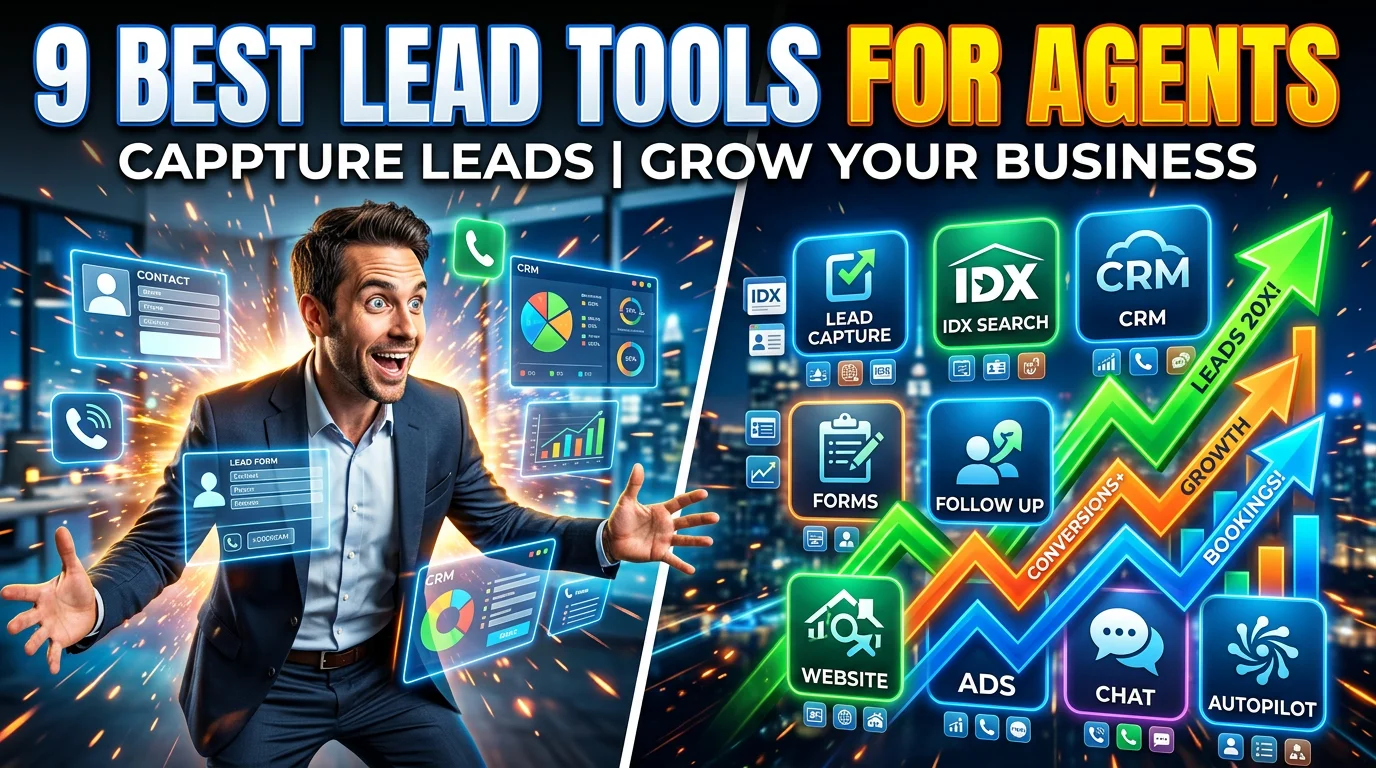
Real estate lead capture software has one job: turn anonymous traffic, ad clicks, listing searches, valuation requests, open house visitors, and old database activity into contact information your team can actually work. A solo agent buying Google Ads needs a different stack than a 12-agent team with ISAs, round robin routing, and hundreds of buyer and seller leads per month.
The stakes are high because internet leads are rarely easy money. Real Geeks cites National Association of Realtors research showing average real estate lead conversion between 0.5% and 1.2%, meaning 200 captured leads may only produce one or two closed clients for the average agent. That does not mean online lead generation is broken. It means the capture page, speed-to-lead process, CRM, follow-up automation, and lead quality all have to work together.
Below are the best real estate lead capture software tools for agents, ranked by pricing transparency, IDX quality, seller lead capture, CRM depth, automation, lead routing, and integrations.
Want More Real Estate Leads Without Guessing at Software?
We help agents build lead generation systems that match their market, budget, and follow-up capacity.
Real Geeks is one of the clearest fits for agents who want an IDX website, buyer lead capture, seller valuation pages, CRM, texting, email follow-up, and optional paid lead generation in one system. It is not the cheapest option on this list, but it is easier to justify than enterprise platforms if you want a proven real estate lead generation website without building every piece yourself.
The platform is built around home search behavior: listing searches, saved searches, property requests, buyer leads, and CRM follow-up. Its pricing page also references Expand and Conquer packages with lead guarantees, although the guarantee depends on package, market tier, contract term, and valid lead rules.
Third-party comparisons commonly list Real Geeks around $399 to $499 per month for two users. Real Geeks’ own pricing page notes additional users at $25 per month up to 10 total users, then lower per-user fees for larger teams. Budget separately for ad spend if you need lead volume.
Best for: solo agents and small teams that want IDX search, CRM, home valuation, landing pages, and follow-up in one real estate-specific platform.
Pros: strong IDX lead capture, real estate-specific CRM, seller and buyer funnels, optional paid lead generation, and a long track record in the real estate industry.
Cons: monthly cost plus ad spend can rise quickly, designs can feel template-driven, and conversion still depends on fast follow-up.
2. Sierra Interactive: Best for teams that need routing, automation, and lead management
Sierra Interactive is a better fit when lead capture is no longer the only problem. If your team already has multiple lead sources, agents, ISAs, nurture plans, and reporting needs, Sierra gives you a more operational lead generation platform.
Sierra’s pricing page lists plans for Solo and Small Teams, Evolving Teams, and Power Teams. It includes details that matter for real estate teams: included users, add-on user pricing, MLS feeds, seller lead sites, single property sites, automations, reporting, agent leaderboards, dialer options, group text, API access, integrations, and Lead Engage as an add-on for $199 per month on eligible plans. Monthly subscriptions may also carry a $500 setup fee, while annual subscriptions show $0 setup.
The standout feature is workflow depth. Sierra can capture leads from IDX searches and seller pages, then route, track, automate, and report on the pipeline.
Best for: teams and brokerages that need serious lead management, agent routing, automation, and reporting.
Pros: deep CRM workflows, strong lead routing, seller lead site options, dialer and texting add-ons, and scalable user pricing.
Cons: more system than many solo agents need, add-ons can increase cost, and the best ROI comes when the team actually follows the process.
3. CINC: Best for high-volume paid lead generation teams
CINC is designed for agents, teams, and brokers that want paid lead generation, IDX websites, CRM, lead routing, nurturing, and accountability in one heavier platform. It is often compared with BoomTown and Sierra because it sits in the same high-commitment category: more expensive, more structured, and better suited to agents who already know they can work a consistent flow of online leads.
CINC does not make simple public pricing easy to verify. Forbes Advisor reported plans starting around $899 per month with a 12-month contract and rising to about $1,500 per month for larger teams. Treat those as market-reported ranges, not a replacement for a current quote.
CINC works best when you have the follow-up muscle to match the spend. If leads sit untouched, it becomes an expensive contact database.
Best for: growth-minded teams with ad budget, lead volume, and a manager watching conversion rates.
Pros: built for paid lead generation, strong CRM and routing, good fit for agents and teams that need multiple lead generation strategies under one roof.
Cons: expensive, contract-heavy, and probably overkill for a solo agent testing online lead generation for the first time.
Not Sure Which Lead Capture Stack Fits Your Market?
We can help you choose between IDX, seller funnels, paid leads, retargeting, and follow-up systems before you commit to another contract.
4. BoomTown: Best for larger teams that want software plus lead concierge support
BoomTown is another enterprise-style real estate lead generation and CRM platform. Its public site describes IDX websites, intelligent CRM, expert lead generation, lead management services, flexible packages, and Success Assurance, a lead concierge service that monitors database activity and engages leads at the right time.
That concierge layer is the main reason BoomTown belongs on this list. Many agents fail because buyer and seller leads go cold after the first missed call. Behavior-based re-engagement can protect ROI for busy teams.
BoomTown lists Launch, Core, Grow, and Advance packages, so expect quote-based pricing that scales with team size, lead generation, and service level.
Best for: established teams that want IDX, CRM, lead generation, and lead concierge support.
Pros: strong team positioning, database engagement support, flexible packages, and a broad all-in-one real estate lead generation system.
Cons: quote-based pricing, likely too much for low-volume agents, and still requires strong internal accountability.
5. AgentFire: Best brand-first real estate websites with built-in IDX
AgentFire is the strongest choice here for agents who care about brand, local authority, neighborhood pages, and website presentation as much as raw lead capture. If your strategy depends on seller trust, luxury positioning, relocation pages, community guides, or hyperlocal SEO, AgentFire is more compelling than a generic landing page tool.
AgentFire’s current pricing page lists design setup packages starting with Ignite at $700 setup, Custom at $2,500 setup, and Firebrand at $6,000 setup. Monthly plans include Pro at $149 per month and Plus at $199 per month. IDX is included with every AgentFire website, and add-ons include Google Business Profile optimization at $500 per month, Home Values Enrich at $29 per month, Neighborhood Quiz at $20 per month, and Team Link from $5 per month per agent.
For lead capture, the strongest use cases are home value pages, IDX registration, neighborhood quiz funnels, local SEO landing pages, and listing lead forms. AgentFire is not trying to be the deepest CRM on this list, so many agents will pair it with a separate CRM or marketing automation tool.
Best for: agents who want a premium local website that captures leads while building listing authority.
Pros: strong design, built-in IDX, useful seller lead add-ons, neighborhood content options, and clear pricing.
Cons: setup fees matter, CRM depth is not the main selling point, and add-ons can stack up.
6. Showcase IDX: Best IDX plugin for WordPress lead capture
Showcase IDX is not a full real estate CRM. It is a strong IDX and property search layer for agents who already have, or want to build, a WordPress website. That makes it a good choice if you want more control over your website, SEO, content, and conversion paths without moving into a closed all-in-one platform.
Showcase IDX’s pricing page lists Essentials starting at $94.95 per month and Premium starting at $124.95 per month. It also notes no setup fees, a 10-day trial, live MLS data during the trial, included agent or admin users, CRM integrations, registration locks, lead activity integrations, Google XML sitemaps, and search tools.
The advantage is control. You can build neighborhood pages, market reports, blog content, home search experiences, and lead magnets around IDX, then connect the data to your CRM.
Best for: agents with a WordPress site who want better IDX search, lead capture, and CRM integrations.
Pros: transparent pricing, no setup fee, IDX registration tools, CRM integrations, and more website ownership than closed platforms.
Cons: not an all-in-one CRM, requires WordPress management, and lead generation depends on traffic.
7. Placester: Best budget-friendly real estate website builder
Placester is a practical option for agents who need a real estate website, lead capture forms, landing pages, and basic marketing presence without paying enterprise platform prices. It is especially useful for newer agents, broker-provided CRM users, and agents who want a cleaner web presence before investing heavily in paid lead generation.
Placester’s public pricing page is dense and changes over time, so agents should verify current plan details before buying. The core appeal is not that Placester beats Sierra or CINC on team workflow. It is that an agent can get a professional website and lead capture foundation in place while keeping the rest of the stack flexible.
Use Placester for contact forms, property pages, seller pages, neighborhood content, and simple landing pages. Pair it with your CRM if you need deeper automation.
Best for: agents who want a lower-cost website and lead capture foundation.
Pros: accessible website builder, real estate-specific templates, lead capture forms, and useful for agents who are not ready for an all-in-one platform.
Cons: less powerful than team-focused systems, pricing details can require careful review, and you may need separate tools for CRM and automation.
8. Leadpages: Best dedicated landing page builder for real estate ad campaigns
Leadpages is not real estate-specific, but it is excellent when you need fast landing pages for seller guides, home valuation offers, open house registrations, relocation guides, webinar signups, and paid ad campaigns. If you already have a CRM and only need better lead capture pages, Leadpages can be cleaner than buying another real estate platform.
Leadpages’ pricing page lists Grow at $49 per month for the first three months, then $99 per month, Optimize at $99 per month for the first three months, then $199 per month, and Scale at $399 per month. All plans include unlimited traffic, custom domains with SSL, AI page creation, forms and webhooks, websites and blogs, and A/B testing. Optimize adds Smart Traffic, heatmaps, auto-personalization, and more integrations.
For agents, the best use is focused conversion: one page, one offer, one audience, one follow-up path. That can beat a generic IDX homepage for paid traffic.
Best for: agents running Facebook Ads, Google Ads, YouTube ads, or direct mail QR campaigns to specific offers.
Pros: fast page creation, A/B testing, unlimited traffic, forms and webhooks, and strong conversion tools.
Cons: not real estate-specific, no built-in IDX, and you must connect it to a CRM and follow-up system.
kvCORE, from Inside Real Estate, is most attractive when your brokerage or team already provides it. Many agents hear about kvCORE as a high-end platform, but the pricing and package structure often depends on brokerage, team, or enterprise agreements rather than a simple public checkout page.
The platform can include IDX websites, CRM, lead generation tools, behavioral automation, squeeze pages, smart campaigns, text and email tools, and lead routing. That makes it a legitimate all-in-one real estate lead capture and lead management system when it is configured well.
The key phrase is “configured well.” kvCORE can be powerful, but agents often underuse it because the system feels broad. If your brokerage gives you kvCORE, do not immediately buy another lead capture platform. First, build your IDX pages, set up seller and buyer squeeze pages, connect smart campaigns, and measure whether the included tool can handle your lead generation efforts.
Best for: agents whose brokerage or team already includes kvCORE, or brokerages that want a broad platform for agents and teams.
Pros: broad all-in-one real estate platform, IDX, CRM, automation, squeeze pages, and brokerage-scale deployment.
Cons: public pricing is not simple, setup quality varies, and agents may need training to get real ROI.
How to choose the right real estate lead capture software
Start with the source of your leads. If you need buyer search traffic, prioritize IDX quality, registration rules, saved searches, and CRM alerts. If you need seller leads, prioritize home valuation pages, neighborhood content, direct mail landing pages, and appointment booking. If you run paid ads, prioritize landing pages, tracking, A/B testing, and speed-to-lead automation.
Then do the math backward. If software costs $500 per month and ads cost $1,500 per month, you spend $24,000 per year before labor. At a 1% close rate, 100 leads produce one client. At a 3% close rate, they produce three clients. That gap is lead quality, response time, scripts, nurture, and whether your CRM keeps leads alive.
When comparing top real estate lead generation companies, ignore vague best real estate lead generation claims. The best lead generation tools combine a lead generation tool, lead management, landing pages, home search, home valuation, lead lists, dialer, AI-powered alerts, AI text, automated lead nurture, real estate data, contact information, phone numbers, CRM integrations, and marketing tools. Look for a free trial when possible, ask about cost per lead or per lead fees, and decide whether you need real estate leads, buyer and seller leads, motivated seller filters, open house capture, skip tracing, free skip tracing, or prospect data for real estate investors selling their property.
For real estate professionals, the best CRM should streamline software features and real estate tools so a real estate agent can generate real estate leads faster and more efficiently. Top agents want a market leader with lead generation services, marketing and lead tracking, home valuation landing pages, tools and marketing support, data and tools, and advanced lead routing. Companies that offer the right approach to lead generation help potential clients fill out a form, stay top of mind, grow your business, supercharge your lead generation, and focus on building relationships. Successful agents using proven lead generation know the real estate business still comes down to building relationships and closing.
My recommendation: choose the lightest tool that solves your actual bottleneck. Real Geeks is the best balanced pick for many solo agents and small teams. Sierra Interactive is the best operational choice for growing teams. AgentFire is best when brand and seller trust matter most. Leadpages is the smart add-on when you already have a CRM and need better campaign pages.
Build a Lead Capture System That Actually Converts
Get a practical plan for your website, landing pages, lead sources, follow-up, and appointment strategy.
The best real estate lead capture software is not the one with the longest feature list. It is the one your team will use every day, connected to offers your market actually wants, backed by follow-up fast enough to turn contact information into conversations.