Recruiting agents is lead generation with a longer sales cycle and a much higher payout. One productive agent can bring a brokerage hundreds of thousands in annual volume. One bad recruiting process can bury that opportunity in spreadsheets, stale MLS exports, forgotten follow-ups, and generic “checking in” emails that top producers ignore.
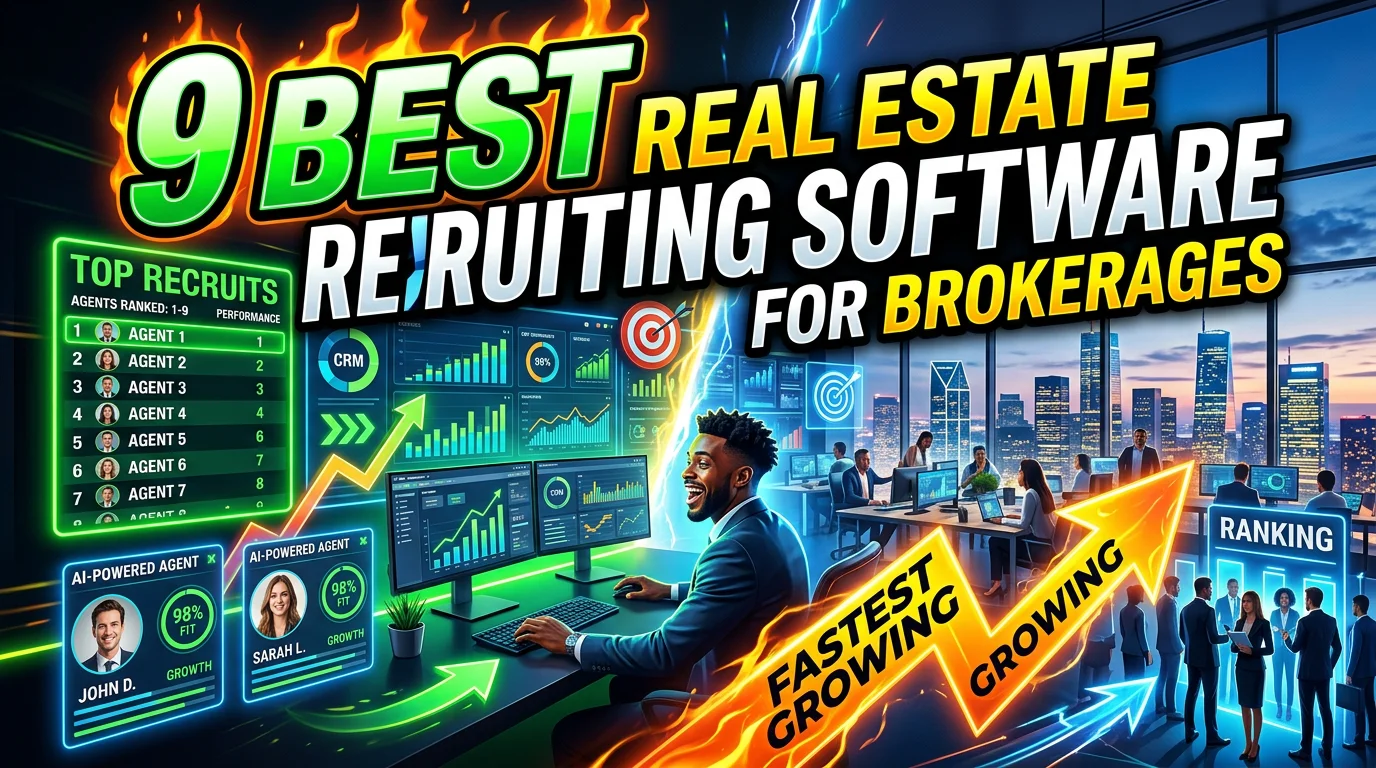
That is why real estate recruiting software has become a serious category. The best platforms identify the right agents, track recruiting conversations, and give brokers timing signals before a competitor reaches out.
Below are the 9 best real estate recruiting software platforms for brokerages, teams, and growth-minded operators. We ranked them by real estate fit, pricing transparency, recruiting workflow, data quality, automation, and whether the tool helps you actually book recruiting conversations instead of just storing names.
A quick note on language: recruiting real estate agents is different from a normal hiring process in the real estate industry. You are often trying to attract top talent, experienced real estate professionals, new agents, and the occasional high-producing REALTOR who can bring referral relationships with them. That is why the top real estate recruiting tools below mix CRM, applicant tracking system features, real estate transaction visibility, and real estate market data. The right real estate recruiting software solutions support agent growth and recruiting campaigns for a real estate agency, not just generic recruitment.
Want More Agent and Client Leads?
We can help you build a real estate growth system that turns traffic, follow-up, and local authority into booked conversations.
How to Choose Real Estate Recruiting Software
Separate your recruiting problem into two buckets.
First, you need agent intelligence. This is the data layer: who is producing, who is rising, who recently changed offices, who is likely under-supported, and who fits your brokerage model. Tools like Relitix and Courted are strongest here because they are built around agent performance and market movement.
Second, you need recruiting execution. This is the CRM layer: pipeline stages, tasks, email sequences, notes, call logs, appointment tracking, landing pages, and campaign reporting. Brokerkit is purpose-built for this. Follow Up Boss, Cloze, HubSpot, and Zoho can work well when you customize them correctly.
The best choice depends on your size:
- Solo team leader or small brokerage: start with Brokerkit, Follow Up Boss, or HubSpot.
- Recruiting-focused brokerage: look at Brokerkit plus Relitix or Courted.
- Large brokerage or multi-office operation: evaluate Courted, Relitix, Sisu, Cloze, and enterprise CRM options.
- Data-driven recruiter: prioritize MLS production data, retention signals, and automated alerts over generic applicant tracking features.
For context, NAR’s 2025 Member Profile reported that 55% of members are affiliated with independent companies and 87% are independent contractors. Recruiting software helps you manage that mobility professionally.
Also evaluate customer support, onboarding, and proactive alerts. In residential real estate, agent movement happens fast; the best AI recruiting software helps hiring managers spot top agents, compare recruiting features, and grow your team with top real estate talent. Real estate hiring works best when recruiting and retention efforts share the same data.
1. Brokerkit
Best for: brokerages that want a purpose-built real estate recruiting CRM
Brokerkit is the most obvious first stop if you are specifically searching for real estate recruiting software. Unlike a generic CRM, it is designed around agent recruiting and retention workflows: prospect lists, pipelines, campaigns, reminders, landing pages, and recruiting activity tracking.
The biggest advantage is focus. A recruiting lead is not the same thing as a buyer lead. You may nurture an agent for 6, 12, or 24 months before the timing is right. Brokerkit keeps those long-cycle relationships out of your client pipeline.
Key details:
- Pricing is publicly listed from about $84/month billed annually for the Starter plan, with higher tiers such as Performance around $339/month before add-ons.
- Built for small teams, offices, and brokerages that want agent recruiting and retention workflows.
- Imports prospects from data sources, spreadsheets, landing pages, APIs, and integration partners.
- Includes email campaigns, task management, recruiting pipelines, and agent alerts.
- Strong fit for broker-owners who have outgrown spreadsheets but do not need a custom enterprise platform.
Pros: Purpose-built for agent recruiting, transparent entry pricing, practical campaigns, and a recruiting-first interface.
Cons: You may still need a separate data source for deeper production intelligence, depending on your market and goals.
Best fit: Independent brokerages and team leaders who want a clean, affordable system to manage agent recruiting follow-up every week.
2. Relitix
Best for: brokerages that want AI-powered agent intelligence and performance data
Relitix is a brokerage intelligence platform. It uses real estate data to help leaders understand agent production, listing behavior, recruiting opportunities, and retention risks. If your strategy depends on knowing which agents are gaining momentum, Relitix belongs on the shortlist.
Relitix has also pushed into lower-cost recruiting intelligence with XPress, which the company describes as a streamlined AI recruiting and agent intelligence option for brokerages that could not previously justify enterprise analytics.
Key details:
- Public pricing references include Relitix XPress from $69.95/month in select markets.
- Advanced recruiting and retention hub pricing is listed as starting as low as $350/month plus MLS fees.
- Focuses on agent performance metrics, listings, brokerage comparisons, recruiting targets, and retention insights.
- Integrates well conceptually with a recruiting CRM such as Brokerkit.
- Strong for identifying who to recruit, not just tracking who you already know.
Pros: Excellent data-driven recruiting angle, affordable XPress entry point, useful for retention and recruiting, and stronger market visibility than a standard CRM.
Cons: Not a complete outreach CRM by itself for every team. MLS coverage, fees, and available data can vary by market.
Best fit: Broker-owners and regional leaders who want to recruit with market intelligence instead of gut feel.
3. Courted
Best for: AI-powered recruiting, retention, and brokerage growth insights
Courted positions itself as a smarter brokerage platform for recruiting and retaining agents. Its recruiting solution uses AI-driven insights to help brokerages identify the right agents, build meaningful connections, and stay ahead of market movement.
Where a basic CRM tells you when you last emailed someone, Courted aims to tell you which agents are worth pursuing and why. Recruiting top producers is a timing, fit, and relationship problem.
Key details:
- Pricing is typically quote-based, so expect a demo and custom package.
- Built around agent recruiting, retention, predictive analytics, and brokerage growth.
- Helps brokerages identify agent opportunities using performance and market signals.
- Pairs well with a relationship-based recruiting process and personalized outreach.
- Particularly relevant for brokerages competing for experienced agents, not just new licensees.
Pros: Strong strategic positioning, AI recruiting insights, retention angle, and a modern brokerage focus.
Cons: Less transparent pricing than Brokerkit or Relitix XPress. Smaller teams may need to validate ROI before committing.
Best fit: Growth-oriented brokerages that want predictive recruiting intelligence and are ready to operationalize it with consistent outreach.
Turn Recruiting Traffic Into Appointments
If your website gets agent or homeowner traffic but does not convert, we can map the funnel and show you where the leads are leaking.
4. Sisu
Best for: teams that want recruiting tied to performance management
Sisu is known as a real estate team operating system for performance tracking, dashboards, coaching, transaction visibility, and business intelligence. It is not only a recruiting platform, but recruiting and onboarding become much easier when you can show agents a data-driven growth environment.
For brokerages and teams, Sisu’s value is in accountability. It helps leaders track activities, appointments, contracts, closings, commissions, and goals. That matters during recruiting because productive agents do not just ask, “What is your split?” They ask, “Can this team help me sell more?”
Key details:
- Pricing is generally demo-based, with third-party software profiles indicating real estate teams use it for transaction management, reporting, performance metrics, and coaching.
- Integrates with tools such as Follow Up Boss, BoomTown, CINC, dotloop, SkySlope, Slack, and Zapier.
- Useful for agent onboarding, coaching dashboards, performance contests, and management visibility.
- Public company materials claim improvements in brokerage/team annual volume and agent annual volume, though results depend on adoption.
Pros: Strong accountability layer, polished dashboards, great for showing recruits a serious performance culture, and useful beyond recruiting.
Cons: If you only need prospect outreach, Sisu may be more system than you need.
Best fit: Teams and brokerages that recruit with training, accountability, coaching, and production systems as the core value proposition.
5. Cloze
Best for: relationship-driven recruiting across brokerage, mortgage, and title
Cloze is an AI-powered real estate CRM and sales platform that can support recruiting, lead routing, relationship management, and cross-department collaboration. It is not a recruiting-only tool, but that can be a strength for larger organizations that want one relationship layer across agents, clients, mortgage, title, and recruiting.
The platform is especially interesting for brokerages that recruit from existing relationships. Cloze can help surface who knows whom, which relationships need attention, and where outreach should happen next.
Key details:
- Pricing is typically custom for real estate brokerage deployments.
- AI-powered CRM built for real estate agents, teams, and brokerages.
- Supports lead routing, marketing, relationship intelligence, collaboration, and recruiting use cases.
- Courted and Cloze announced a partnership focused on data-driven recruiting and retention for modern brokerages.
- Strong for organizations that treat recruiting as relationship management, not just sales development.
Pros: Deep real estate CRM orientation, AI relationship prompts, broader brokerage use cases, and strong team concept support.
Cons: Not the simplest option if all you need is a lightweight recruiting pipeline.
Best fit: Brokerages with multiple departments, large databases, and relationship-based recruiting strategies.
6. Follow Up Boss
Best for: teams that want to adapt their existing real estate CRM for recruiting
Follow Up Boss is one of the most popular CRMs for real estate teams. While it is usually used for buyer and seller lead follow-up, many teams also use it to manage agent recruiting pipelines because the core mechanics are the same: leads, stages, tasks, tags, smart lists, calls, texts, emails, and accountability.
If your team already runs Follow Up Boss, creating a recruiting pipeline may be faster than buying another system. Use separate stages like Target Agent, Contacted, Coffee Scheduled, Interviewed, Offer Made, Joined, and Nurture. Then build action plans for each recruiting stage.
Key details:
- Public pricing has historically started around $69/user/month, with team tiers and add-ons varying by package.
- Strong calling, texting, email, action plans, smart lists, and integration ecosystem.
- Works well if recruiting is handled by team leaders already living inside the CRM.
- Can connect recruiting activity with your broader real estate lead management software stack.
Pros: Familiar to many agents, excellent follow-up workflows, broad integrations, and easy to adapt if you already use it.
Cons: You must customize it for recruiting; it will not provide agent production intelligence on its own.
Best fit: Real estate teams that already use Follow Up Boss and want to start recruiting without adding another platform immediately.
7. HubSpot CRM
Best for: brokerages that want flexible marketing automation and reporting
HubSpot is not real estate-specific, but it is one of the strongest general-purpose CRM and marketing automation platforms. For recruiting, that flexibility is useful. You can build landing pages, forms, email nurture campaigns, deal pipelines, meeting links, lead scoring, and dashboards around agent attraction.
HubSpot works best when your recruiting strategy includes content: agent career pages, local market reports, webinars, downloadable business plans, and email nurture sequences.
Key details:
- Free CRM tools are available; paid Sales, Marketing, and Service hubs scale by seat and feature level.
- Strong landing pages, forms, email automation, meeting scheduling, workflows, reporting, and integrations.
- Good for inbound recruiting funnels and agent nurture campaigns.
- Can track recruiting source ROI if configured properly.
Pros: Flexible, scalable, strong marketing tools, and excellent reporting for inbound recruiting.
Cons: Requires setup. Real estate-specific data, compliance language, and recruiting stages must be built manually.
Best fit: Brokerages using content, webinars, events, and agent attraction funnels as a major recruiting channel.
8. Zoho Recruit
Best for: brokerages that need applicant tracking plus candidate pipelines
Zoho Recruit is an ATS and recruiting CRM. It is built more for hiring employees than recruiting independent contractor agents, but it works for brokerages hiring staff, property managers, leasing teams, or newer agents through a structured process.
Key details:
- Paid plans are commonly listed from roughly $25 to $50 per recruiter/month depending on billing and feature level.
- Includes candidate tracking, job posting, resume parsing, workflow automation, interviews, and reporting.
- Integrates with Zoho CRM and Zoho Campaigns.
Pros: Affordable, mature ATS features, good for staff hiring, and flexible enough for agent pipelines.
Cons: Less real estate-specific than Brokerkit, Relitix, or Courted.
Best fit: Brokerages recruiting admins, transaction coordinators, property managers, leasing staff, and newer agents.
9. Recruit CRM
Best for: high-volume recruiting teams that want agency-style workflow
Recruit CRM is a recruiting CRM and applicant tracking platform used by staffing and search teams. It is not built specifically for real estate, but it has strong pipeline management, candidate records, email sequences, automation, and reporting for teams that run recruiting like a sales operation.
Key details:
- Subscription pricing is generally shown by user and plan.
- Includes candidate pipelines, email sequencing, tasks, notes, reporting, and automation.
- Strong for dedicated recruiting teams that need accountability and process.
Pros: Excellent recruiting workflow, scalable for teams, and built around recruiter productivity.
Cons: Generic recruiting language and workflows need customization for real estate; compare with niche options such as OnTask Recruiter if you need more real estate agent recruiting software choices.
Best fit: Larger brokerages or recruiting departments that want disciplined recruiting operations.
The Best Stack for Most Brokerages
For most brokerages, the best answer is not one tool. It is a small stack:
- Relitix or Courted to identify and prioritize recruiting targets.
- Brokerkit to manage outreach, campaigns, and recruiting follow-up.
- Sisu, Cloze, or Follow Up Boss to connect recruiting with performance, relationship data, or the team’s existing operating system.
That combination gives you data, execution, and accountability. It prevents the common failure: buying a list, sending generic emails, and letting the process die.
If you are still early, start simpler. Use Brokerkit if you want recruiting-specific software. Use Follow Up Boss or HubSpot if you already own them and need to prove the process before buying a specialist platform. Add Relitix or Courted when you are ready to recruit based on market signals instead of memory.
Final Recommendation
If you want the best all-around real estate recruiting software, start with Brokerkit. It is built for the exact workflow most brokerages need: organize agent prospects, run campaigns, assign tasks, and keep long-term recruiting conversations alive.
If you want the best data-driven recruiting intelligence, look at Relitix or Courted. They help answer the harder question: which agents should you pursue right now?
And if your recruiting pitch is built around helping agents sell more, do not ignore Sisu or Cloze. Sometimes the best recruiting software is the operating system that proves your brokerage can help an agent grow.
Build a Recruiting and Lead Gen Engine That Compounds
Book a free consultation and we’ll help you identify the fastest path to more agent conversations, better follow-up, and stronger local authority.