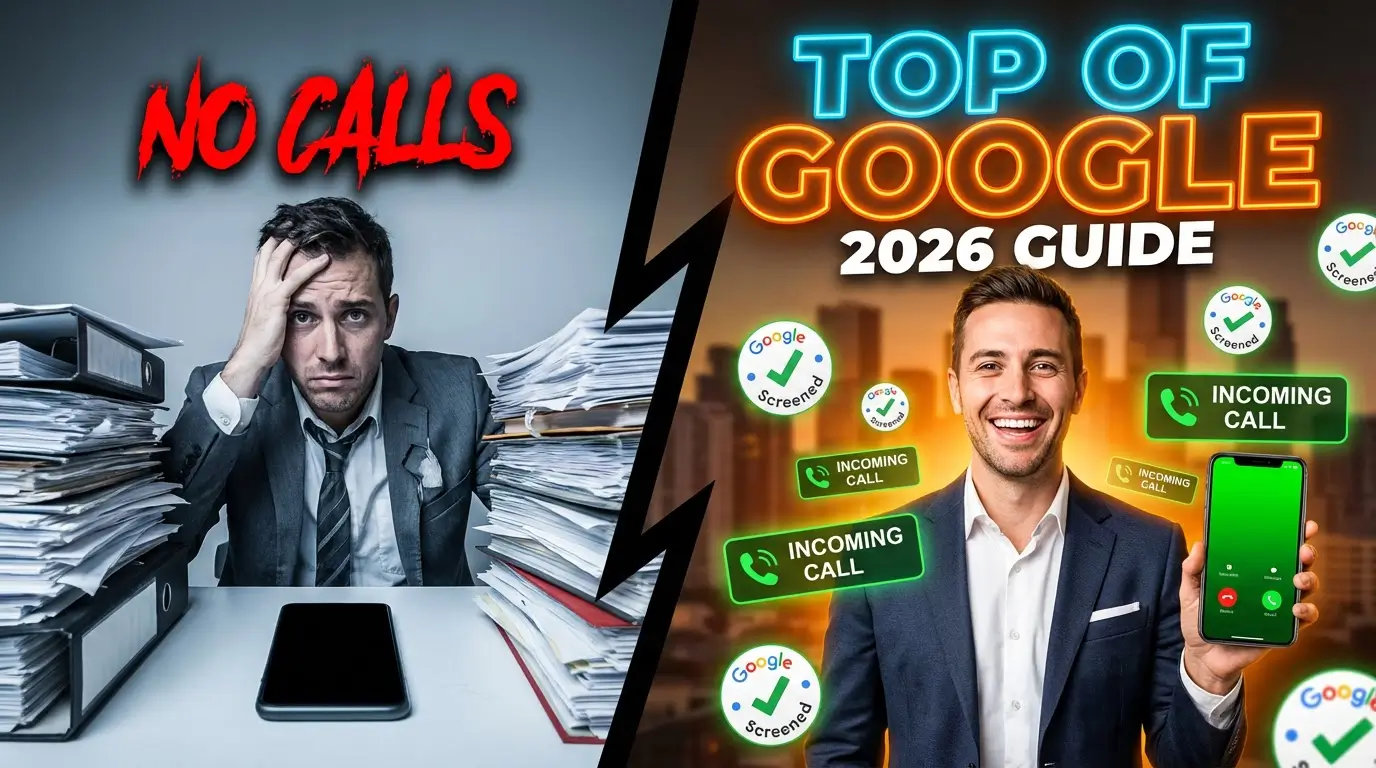
If you’ve searched “real estate agent near me” lately, you’ve seen them: a tight row of three listings sitting above the paid ads and above the organic results. That’s the Google Local Services Ads (LSA) pack — prime digital real estate on Google’s most valuable page.
Most agents are still ignoring LSA. That means less competition, lower cost-per-lead, and a massive opportunity for agents who move first. This guide breaks down everything you need to know to set up, optimize, and dominate Google Local Services Ads in 2026.
Want Leads Coming to You — Not the Other Way Around?
Book a free consultation and we'll map out the exact digital lead strategy that fits your market, budget, and goals.
What Are Google Local Services Ads?
Google Local Services Ads are a pay-per-lead advertising format that places your profile at the very top of Google search results. Unlike traditional Google Ads (pay-per-click), you only pay when a qualified lead contacts you directly — either by phone call or message.
LSAs show up when buyers and sellers search queries like:
- “real estate agent near me”
- “Realtor in [city]”
- “homes for sale in [neighborhood]”
- “sell my house in [city]”
The ad unit displays your name, photo, Google review rating, years in business, and service area. It’s the most prominent spot on the page — above everything else Google shows.
The Google Screened Badge
To run LSAs, real estate agents must go through Google’s verification process and earn the Google Screened badge. This involves a background check and license verification. The badge appears on your ad and signals to potential clients that Google has vetted you as a legitimate professional.
In a market where trust is currency, this badge gives LSA leads a warmer starting temperature than virtually any other ad format.
Why LSA Works Better Than Standard Google Ads in 2026
Traditional PPC ads (Google Search Ads) charge you every time someone clicks your ad, even if they bounce immediately. With a $15–$30 average cost-per-click in real estate, a week of testing can burn $500 without a single conversation.
LSA flips the model:
| Feature | Google Search Ads | Google Local Services Ads |
|---|
| Payment model | Pay-per-click | Pay-per-lead |
| Average lead cost | $30–$100+ per lead | $15–$50 per qualified lead |
| Position on page | Below LSA pack | Top of page (#1 position) |
| Trust signals | None built-in | Google Screened badge |
| Setup complexity | High | Moderate |
Because you only pay when someone actually calls or messages, your budget goes further. And because you rank above PPC ads, you capture intent from prospects who haven’t even seen a competitor’s ad yet.
How to Set Up Google Local Services Ads for Real Estate
Step 1: Check Eligibility
Real estate agents are an eligible business category for LSAs in the United States and Canada. You’ll need:
- A valid real estate license
- A Google Business Profile (or willingness to create one)
- The ability to pass a background check
Step 2: Create Your LSA Profile
Head to ads.google.com/local-services-ads and select “Real Estate Agent” as your business category. Fill out:
- Business name — use your personal brand or team name
- Service areas — cities, zip codes, or radius around your office
- Services offered — buyer’s agent, seller’s agent, rentals, etc.
- Business hours — set these accurately; Google tracks your call pickup rate
- License information — your state real estate license number
Step 3: Complete the Google Screened Verification
Google will run a background check through a third-party provider (typically Evident or Checkr). This usually takes 3–7 business days. Your license will be verified against your state’s real estate board records.
Don’t skip this step. The Google Screened badge is what separates your ad from a generic web listing and dramatically improves click-through rates.
Step 4: Connect Your Google Business Profile
Your LSA profile pulls reviews directly from your Google Business Profile. The more 5-star reviews you have, the better your ad performs. Before launching, make sure your GBP is claimed, verified, and has at least 5–10 recent reviews.
Not optimized yet? Read our guide on Google Business Profile optimization for real estate agents to max out your profile before your LSA goes live.
Step 5: Set Your Budget
LSA budgets are set weekly. Google recommends a starting point that generates roughly 10 calls per week — in most markets, that’s $800–$1,500/month. Your actual cost-per-lead will vary by:
- Local market saturation
- Your call pickup rate
- Review score and recency
- How competitive your target service areas are
Start conservatively. Track cost-per-lead in your first 30 days, then scale what’s working.
Not Sure What Budget Makes Sense for Your Market?
Our team works with real estate agents across the country. We'll tell you exactly what LSA leads cost in your area and whether it's worth it.
How Google Ranks Your LSA Ad
Unlike traditional ads, LSA rankings aren’t purely based on bid. Google uses a combination of factors:
1. Call Pickup Rate
This is the single most important factor most agents ignore. Google tracks how often you answer calls that come through your LSA. If you miss calls, Google deprioritizes your ad. The agents who dominate LSA packs answer their phones — or have someone do it for them.
Solutions:
- Forward LSA calls to your mobile and answer every call during business hours
- Set up a real estate ISA (Inside Sales Agent) to handle overflow
- Use a professional answering service for after-hours calls
2. Review Recency and Volume
Google favors agents with a steady stream of recent 5-star reviews. It’s not enough to have 50 reviews from two years ago — you need reviews coming in consistently. Build a system: after every closing, send clients a direct Google review link.
3. Budget Adequacy
Underfunding your LSA is a self-defeating strategy. If your budget runs out by Wednesday, you get zero calls Thursday through Sunday — and Google’s algorithm notes the inconsistency. Set a budget that keeps your ad active 7 days a week.
4. Profile Completeness
A complete, detailed profile ranks higher. Fill in every field: upload a professional headshot, list all services you offer, set accurate hours, and write a compelling business description.
Maximizing LSA Lead Quality
Not all LSA leads are created equal. Here’s how to filter for quality and avoid budget waste:
Dispute Irrelevant Leads
Google allows you to dispute leads that don’t match your services. If someone calls asking about commercial property and you only do residential, dispute that charge. Google refunds valid disputes — this directly lowers your effective cost-per-lead.
Use Geographic Targeting Precisely
Don’t carpet-bomb an entire metro area. Start with your core farm area — the neighborhoods where you have the most listings, closings, and reviews. High concentration in a tight area beats thin coverage across a sprawling region.
Respond Within 5 Minutes
LSA leads are hot. They just searched, saw your name, and called or messaged. Speed-to-lead is everything — the agents who respond within 5 minutes convert at dramatically higher rates than those who wait an hour. If you can’t guarantee immediate follow-up, pair LSA with an ISA or answering service.
For a deeper look at follow-up speed, read our piece on AI speed-to-lead and why response time makes or breaks conversions.
LSA vs. Other Lead Channels: Where Does It Fit?
LSA is a high-intent lead channel. The people calling you have just searched for a real estate agent — they’re in buying or selling mode right now. That’s different from Facebook Ads (interruption-based, lower intent) or Zillow leads (platform-dependent, expensive).
Here’s how to think about your channel mix:
- LSA → High-intent, local, immediate — ideal for fast conversion
- Facebook Ads → Awareness and nurture, good for building a pipeline
- Google Business Profile → Long-term organic presence that feeds LSA rankings
- Retargeting Ads → Re-engage people who visited your site but didn’t convert
The agents who win in 2026 aren’t betting everything on one channel. They’re building layered systems where LSA captures the immediate hand-raisers while other channels warm up the longer-term leads.
Common LSA Mistakes Real Estate Agents Make
Setting it and forgetting it. LSA requires active management. Check your dashboard weekly, dispute bad leads, request reviews after every closing, and adjust your budget as your call pickup rate changes.
Using a team photo instead of a personal headshot. Google requires an individual agent’s photo as the primary image. Use a professional, high-quality headshot — it’s one of the most visible trust signals on your ad.
Ignoring messages. Some leads will message instead of call. Agents who respond to messages within minutes book more appointments. Turn on message notifications and treat them like phone calls.
Launching before getting reviews. An LSA profile with 2 reviews will get crushed by competitors with 30+. Spend 2–3 weeks building your GBP review count before activating your LSA spend.
Targeting too broad an area. Wider isn’t better. Tight, high-density targeting in your core market produces better leads at lower cost per lead than spreading thin across an entire metro.
Is Google LSA Right for Your Real Estate Business?
LSA makes the most sense for agents who:
- Work a defined geographic area (city or specific neighborhoods)
- Can answer or respond to calls quickly (or have support in place)
- Have a solid Google Business Profile with reviews
- Want inbound leads rather than cold outreach strategies
- Are willing to invest $1,000–$2,000/month for high-intent leads
If you’re still building your review base or just starting in a new market, spend 30–60 days getting your GBP dialed in first, then activate LSA once you have the social proof to compete.
If you’re an established agent with a strong local presence and struggling to replace the leads that used to come from portals, LSA is likely your fastest path back to a full pipeline.
Ready to Put Your Business at the Top of Google?
Let's build a Google LSA strategy that fits your market and budget. Book a free consultation — no obligation, just a real conversation about what's working right now.
The Bottom Line
Google Local Services Ads are one of the highest-ROI lead generation tools available to real estate agents in 2026. The pay-per-lead model, top-of-page placement, and Google Screened trust badge create a powerful combination that most agents are still sleeping on.
The formula isn’t complicated: set up your profile, get verified, build your reviews, answer your phone, and dispute bad leads. The agents doing these five things consistently are pulling in 10–20 high-intent leads per month at costs that beat every major portal.
The window before your local market gets saturated is open right now. The agents who move fastest will own the LSA pack in their area — and everyone else will be fighting over scraps.