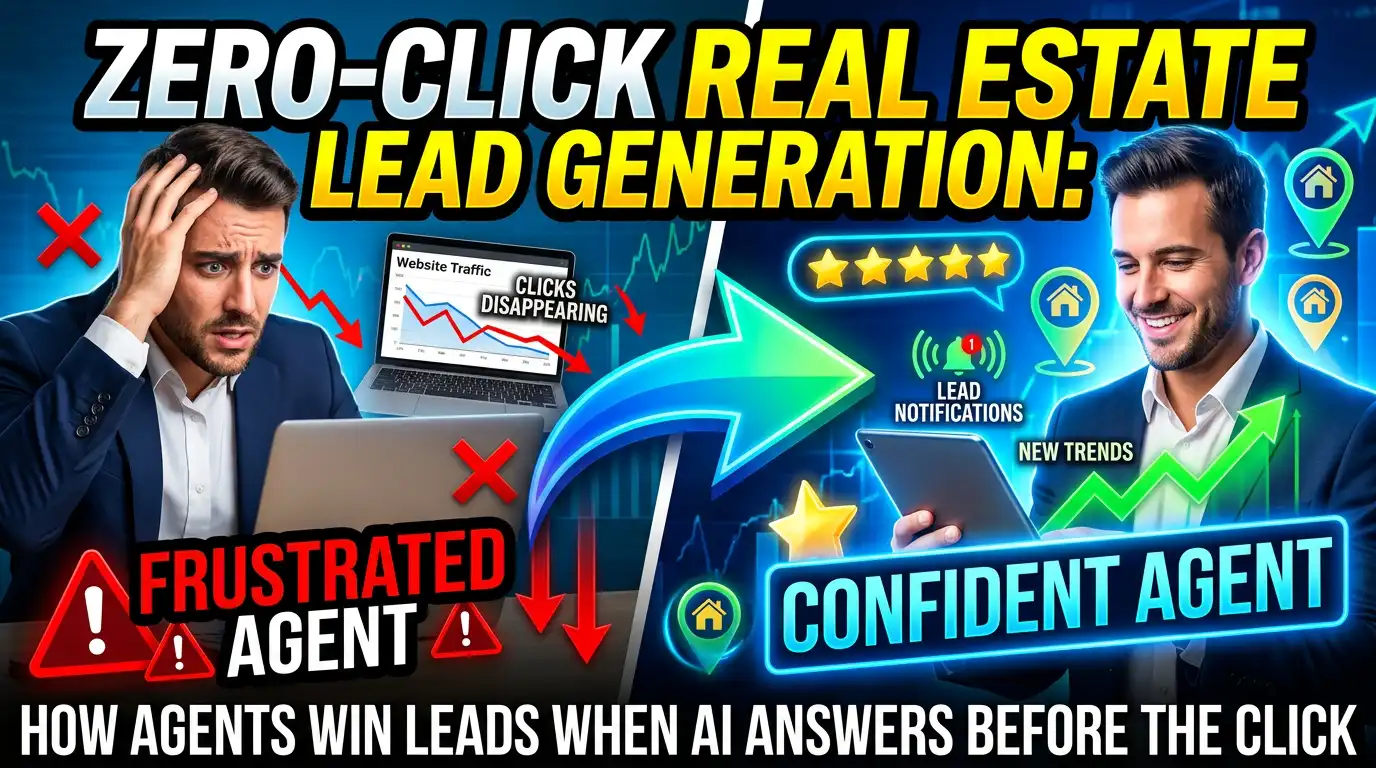
Zero-click real estate lead generation is the new reality for agents who depend on Google, local search, and content to create appointments. Buyers and sellers are no longer only typing short keywords into search engines, scanning search results, and clicking through to ten websites. They ask AI, ChatGPT, Gemini, Perplexity, Siri, and Google AI Overviews questions like “who is the best real estate agent near me,” “what neighborhoods should I consider,” or “which listing agent should I interview before selling?” Sometimes the answer appears before the click ever happens.
That sounds scary if your entire strategy is based on website traffic. It is a major opportunity if your digital marketing is built to be cited, trusted, and remembered. In a zero-click world, the goal is not just ranking. The goal is visibility inside the answer, stronger brand recall, more Google Business Profile actions, and a follow-up path that turns AI search attention into real conversations.
Why Zero-Click Search Matters for Real Estate Agents
Traditional SEO helps a real estate agent rank for searches like “homes for sale in Denver” or “best listing agent in Tampa.” AI-powered search changes the behavior around those searches. A seller may ask AI to summarize the local market and recommend what to do next. A buyer may ask AI to compare neighborhoods, schools, commute times, and property search options. An investor may ask AI to explain rental demand before contacting anyone.
Recent industry coverage shows how quickly this search landscape is moving. HousingWire reported that a rising share of consumers receive recommendations for agents, brokerages, and service providers without visiting a website. Luxury Presence also noted that AI Mode queries are longer and more conversational than traditional search. That means people search for homes and agents with complete questions instead of short keywords.
For lead generation, the implication is simple: your online presence must help AI systems understand why you are a credible local expert before a consumer fills out a form.
What Zero-Click Lead Generation Actually Means
Zero-click lead generation does not mean people never visit your website. It means many prospects encounter your expertise somewhere else first: an AI Overview, a ChatGPT answer, a Google Business Profile, a map result, a review snippet, a brokerage profile, a local article, or a social post.
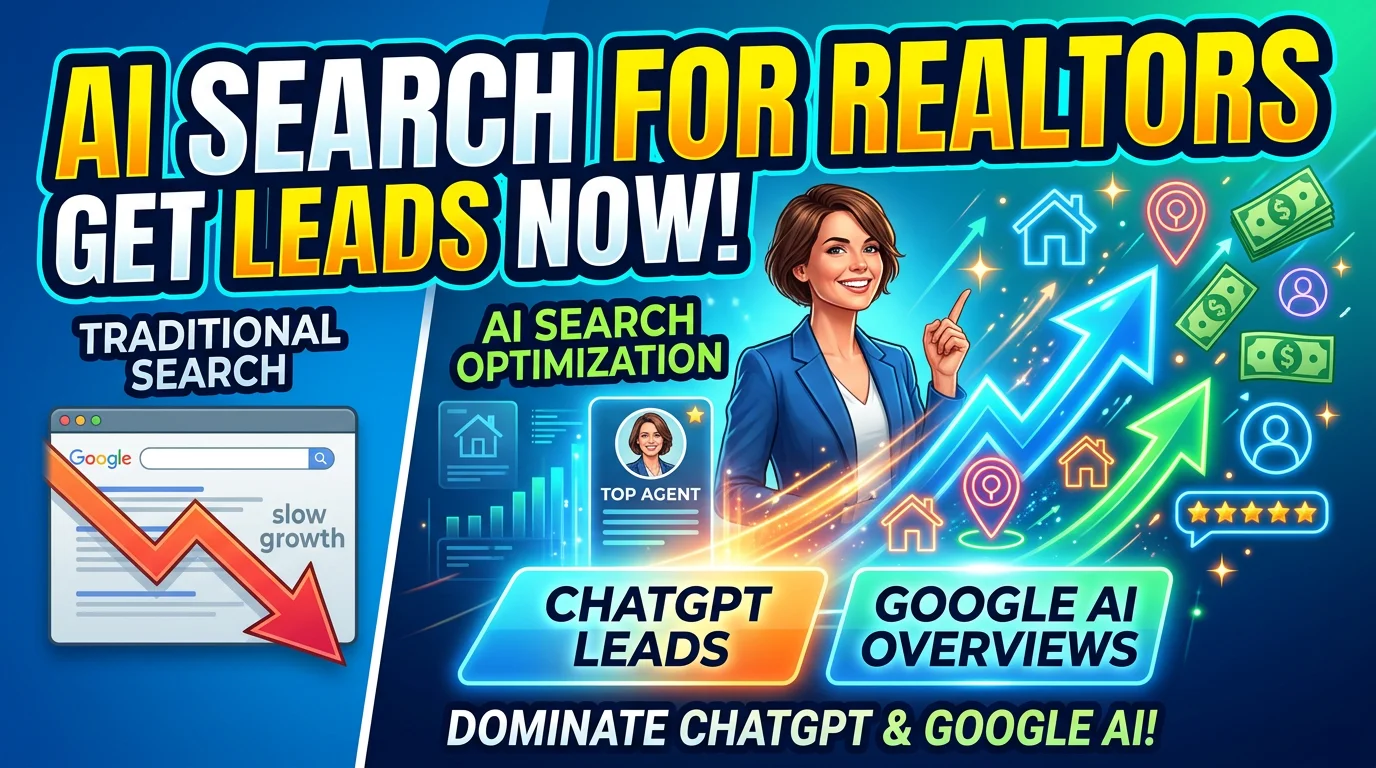
AI search optimization, answer engine optimization, AEO, GEO, and generative engine optimization are all names for the same strategic shift. Traditional SEO optimizes a page for rankings and clicks. AI search optimization helps AI systems, search engines and AI, and ai-powered search engines retrieve, trust, and recommend your business.
The best agents will do both. They will still publish useful real estate SEO content, but they will also optimize their entity data, reviews, local authority, structured data, and conversion paths for AI-driven search.
The Five Assets That Create Zero-Click Visibility
1. A complete Google Business Profile
Your Google Business Profile is one of the most important assets for zero-click search and AI visibility. Google AI Overviews, Gemini, Maps, and local search systems rely heavily on business profile data. ChatGPT and other AI platforms may also compare business information across Bing Places, directories, social profiles, brokerage pages, and websites.
Optimize every section: primary category, services, service areas, appointment link, hours, phone number, website, photos, products, posts, questions, and reviews. Keep your name, address, phone, and URL consistent. A clean business profile improves AI search visibility because it gives AI models a stronger confidence signal.
2. Reviews that prove local authority
Reviews do more than improve conversion. They help real estate AI search systems understand reputation, geography, property type, and client outcomes. A review that says “helped us sell our home in Plano after multiple offers” gives more context than “great agent.”
Ask clients to be specific naturally. Encourage them to mention the city, neighborhood, transaction type, and result when it is honest. Respond to reviews with useful context. This builds social proof for humans and a richer digital footprint for AI systems.
3. Answer-first local content
Generic content rarely wins in AI search. Specific local content does. Publish pages and posts that answer real client questions with actual market knowledge: neighborhood comparisons, seller timing, pricing strategy, inspection issues, school-zone questions, HOA rules, commute patterns, luxury homes, downsizing, probate, relocation, and first-time buyer concerns.
Short keywords still matter, but conversational search rewards depth. Instead of only targeting “real estate agent,” answer questions like “is now a good time to sell in [city]?” or “which neighborhoods near [city] are best for move-up buyers?” When people ask AI those questions, your content has a better chance to become part of the answer.
Want More Leads From Search and AI Discovery?
We’ll audit your current lead generation system and show you where SEO, AI search, paid ads, and follow-up can create more booked appointments.
4. Structured data and machine-readable proof
Structured data helps search platforms understand your business and content. Use LocalBusiness, RealEstateAgent, Organization, Article, FAQ, Breadcrumb, Review, and listing markup where appropriate. Markup is not a shortcut, but it helps AI agents and traditional search engines extract important facts like your service area, brokerage, author, contact details, and page purpose.
If you publish listing pages, make details like price, bedrooms, bathrooms, location, status, open house times, and virtual tour media easy to read. Listings for AI-driven search should be clear for humans and machines.
5. Mentions beyond your own website
AI platforms compare sources. Your website matters, but so do local news quotes, podcast appearances, community pages, association profiles, YouTube descriptions, LinkedIn posts, chamber listings, and brokerage bios. These places AI may scan can reinforce that you are a real real estate professional in a real local market.
A strong online presence is not one perfect page. It is a network of consistent proof.
How to Turn Zero-Click Attention Into Actual Leads
Zero-click visibility is valuable only if it creates action. The prospect may not click the first time they see your name, so your lead generation system needs multiple conversion paths.
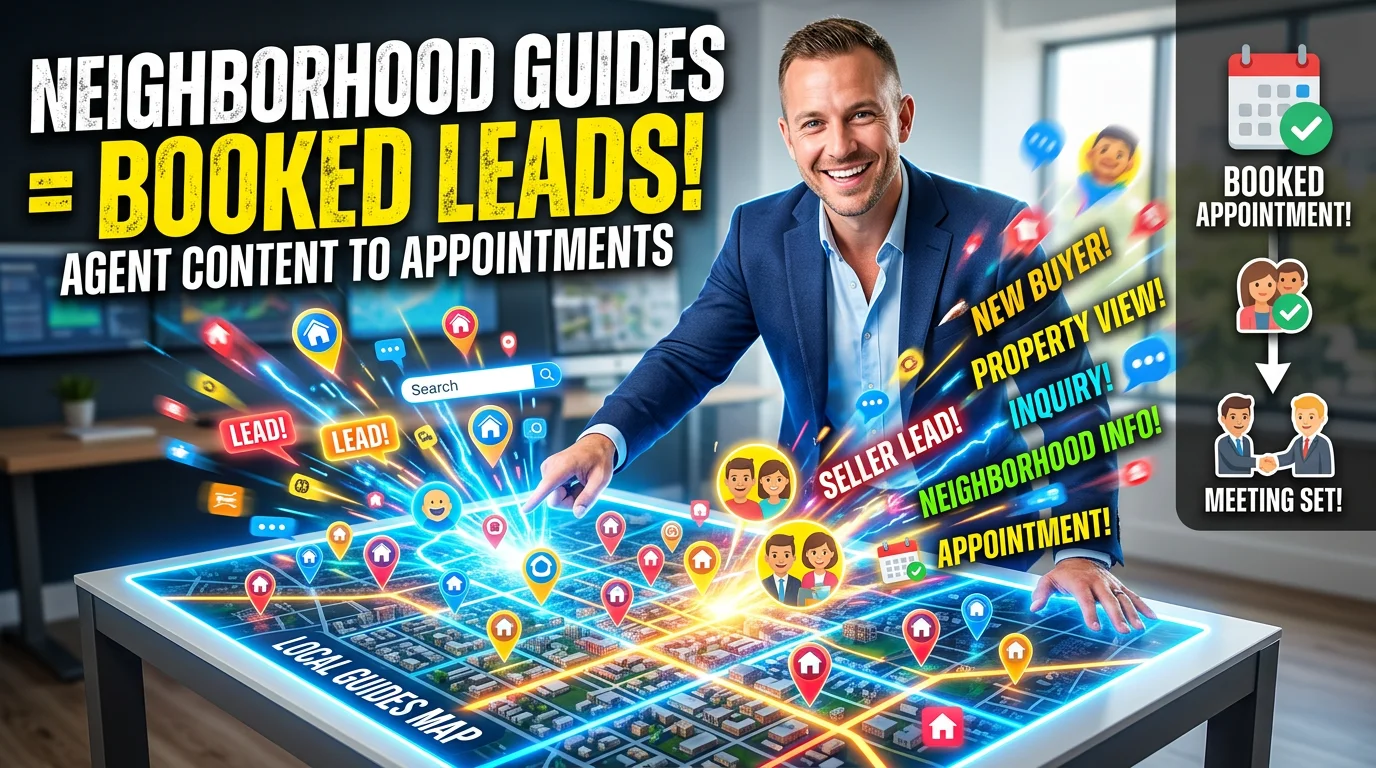
First, make your Google Business Profile conversion-ready. Add the appointment link, phone number, website link, updated photos, service descriptions, and posts that point to useful offers. Second, create lead magnets that match the questions AI search users ask: home value reports, seller timing checklists, neighborhood guides, relocation guides, and buyer cost breakdowns. Third, connect every page to follow-up.
For example, a page about seller timing can point to a home valuation funnel. A neighborhood guide can support hyperlocal SEO for real estate agents. A content strategy should connect to your real estate lead follow-up system. Internal links help users, search engines, and AI systems understand your topical authority.
Content Structure That Works for AI Overviews and ChatGPT
AI search optimization works best when content is easy to parse. Use question-based headings, concise definitions, short paragraphs, examples, FAQs, and local details. Tools like ChatGPT and Google’s AI search experiences look for content that answers the user’s intent directly.
A strong page might include:
- A plain-English answer near the top.
- Local examples from your market.
- Comparisons between neighborhoods, price ranges, or property types.
- A checklist or step-by-step process.
- Review snippets or proof points.
- Schema markup and clear author information.
- A call to action for a consultation or valuation.
This is where the use of AI can help real estate agents move faster. Use AI tools for local outline ideas, question clustering, and content gap analysis. Then add the parts AI cannot fake: real client questions, local market knowledge, recent listing experience, and specific advice.
A 30-Day Zero-Click Lead Generation Plan
Week 1: Fix your data. Search your name, brokerage, phone number, website, and service area. Update your Google Business Profile, Bing Places, Realtor.com, Zillow, LinkedIn, Facebook, Yelp, and local directories. Consistency improves ai search optimization and real estate search trust.
Week 2: Build your question map. List the questions buyers and sellers ask before hiring you. Group them by intent: pricing, timing, neighborhoods, relocation, luxury homes, first-time buyers, investment, downsizing, probate, divorce, and new construction. This gives you content that matches how people ask AI.
Week 3: Publish three local authority pages. Start with pages that can lead to appointments: “Should I sell my house in [city] this year?”, “Best neighborhoods in [city] for [audience],” and “How much does it cost to buy a home in [city]?” Optimize each page for traditional seo and AI-powered search.
Week 4: Reinforce trust. Request specific reviews, post updates to your Google Business Profile, share pages on social, record a short video, add a virtual tour where relevant, and pitch one local publication with useful market commentary. Strong AI visibility comes from repeated proof across platforms.
Build a Lead System That Survives Zero-Click Search
If AI Overviews and ChatGPT are changing your market, we can help you build the content, offers, and follow-up that turn visibility into appointments.
What Agents Should Not Do
Do not panic and abandon SEO. Traditional search still creates leads, and traditional seo helps AI systems discover and trust your content. Do not publish generic AI-written city pages with no market knowledge. Do not use fake reviews, fake office locations, or misleading service areas. Do not optimize for AI while ignoring conversion.
Also, do not assume portals will solve this for you. Portal leads can work, but they rent attention. Zero-click lead generation helps build an owned brand asset that can compound over time.
How to Measure Progress
Clicks are no longer the only metric. Track Google Business Profile calls, direction requests, website clicks, branded searches, form submissions, consultation bookings, review velocity, impressions on long-tail queries, and assisted conversions. Also test AI platforms directly. Ask AI questions a real prospect might ask: “who is the best listing agent in [city]?” “what should I know before buying in [neighborhood]?” “which agents specialize in [property type]?”
You will not control every AI answer, but you can improve the evidence available. Over time, stronger data, better content, and more local authority increase the odds that AI mentions you.
Final Takeaway
AI is changing the real estate lead generation funnel, but it is not replacing trust. It is changing where trust is formed. Buyers and sellers may ask AI before they call an agent, but AI still needs proof: reviews, business profile data, structured data, local content, social proof, and consistent market expertise.
The agents who win will not choose between SEO and AI search. They will combine real estate SEO, AI search optimization, local authority, and smart follow-up into one system. When prospects ask AI who they should trust, your job is to make the answer obvious.
Get Your Free Lead Generation Consultation
We’ll identify your best opportunities for SEO, AI search visibility, lead capture, and follow-up so you can turn more local demand into booked appointments.